Deep Learning with Softmax and SVM using Worst Omega Optimization for Multi-Class Financial Prediction
- Publication Date
- April 30, 2026
- Volume / Issue
- Vol. 5, Issue 1 (pp. 31-45)
- DOI Identifier
- 10.58190/imiens.2026.169
Deep Learning with Softmax and SVM using Worst Omega Optimization for Multi-Class Financial Prediction
Official publication asset for Intelligent Methods In Engineering Sciences
subjectAbstract
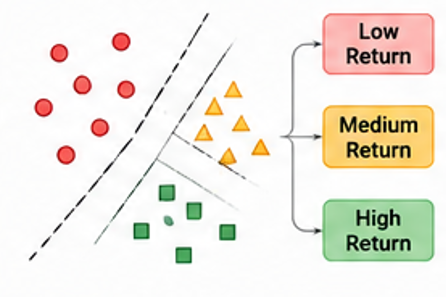
This study proposes a hybrid framework for multi-class financial prediction and portfolio optimization by integrating deep learning-based classification models with worst-case Omega optimization. The framework employs a neural network architecture combined with Softmax and multi-class Support Vector Machine (SVM) classifiers to categorize assets into low-, medium-, and high-return classes. These classifications are subsequently utilized to construct portfolios using a worst-case Omega optimization model that explicitly accounts for downside risk and uncertainty. The empirical analysis is conducted on two benchmark datasets, BSE 30 and DOW 30, using a rolling window approach. The results demonstrate that the SVM-based classification model outperforms the Softmax model in terms of class separability and stability across varying market conditions. Portfolios constructed using SVM-selected assets consistently achieve higher returns, lower volatility, and improved risk-adjusted performance, as evidenced by superior Sharpe, Sortino, STARR, and Omega ratios. Furthermore, the worst-case Omega optimization framework provides enhanced protection against extreme losses by effectively controlling tail risk, as reflected in lower Value-at-Risk (VaR) and Conditional Value-at-Risk (CVaR). Comparative analysis with equally weighted portfolios confirms the ability of the proposed framework to generate persistent excess returns across different risk-aversion levels. Overall, the study highlights the importance of combining accurate classification techniques with robust optimization methods for effective portfolio management. The proposed approach offers a flexible and reliable solution for decision-making in dynamic and uncertain financial markets.
Author Information & Affiliations
- Simrandeep Kaur— Entrepreneurship and Management Processes International (EMPI) Business School, Chattarpur, New Delhilinkhttps://orcid.org/0009-0005-1666-2476
format_list_numberedReferences (29)
Cited Literature- 1
H. Markowitz, “Modern portfolio theory,” J. Finance, vol. 7, no. 11, pp. 77–91, 1952.
- 2
H. Markowitz, “The utility of wealth,” J. Polit. Econ., vol. 60, no. 2, pp. 151–158, 1952.
- 3
Y. LeCun, Y. Bengio, and G. Hinton, “Deep learning,” nature, vol. 521, no. 7553, pp. 436–444, 2015.
- 4
T. Fischer and C. Krauss, “Deep learning with long short-term memory networks for financial market predictions,” Eur. J. Oper. Res., vol. 270, no. 2, pp. 654–669, 2018.
- 5
J. B. Heaton, N. G. Polson, and J. H. Witte, “Deep learning for finance: deep portfolios,” Appl. Stoch. Models Bus. Ind., vol. 33, no. 1, pp. 3–12, 2017.
- 6
M. Ashrafzadeh, M. Sadrani, and S. H. Zolfani, “Deep learning and machine learning models for portfolio optimization: Enhancing return prediction with stock clustering,” Results Eng., p. 106263, 2025.
- 7
Y. Zhang, Y. Liu, W. Liu, and X. Yang, “An end-to-end deep learning framework for the portfolio optimization with stop-loss orders,” Appl. Soft Comput., vol. 181, p. 113465, 2025.
- 8
W. Huang, Y. Nakamori, and S.-Y. Wang, “Forecasting stock market movement direction with support vector machine,” Comput. Oper. Res., vol. 32, no. 10, pp. 2513–2522, 2005.
- 9
C. Cortes and V. Vapnik, “Support-vector networks,” Mach. Learn., vol. 20, no. 3, pp. 273–297, 1995.
- 10
S. Gu, B. Kelly, and D. Xiu, “Empirical asset pricing via machine learning,” Rev. Financ. Stud., vol. 33, no. 5, pp. 2223–2273, 2020.
- 11
X. Martínez-Barbero, R. Cervelló-Royo, and J. Ribal, “Portfolio optimization with prediction-based return using long short-Term memory neural networks: testing on upward and downward European markets,” Comput. Econ., vol. 65, no. 3, pp. 1479–1504, 2025.
- 12
C. Keating and W. F. Shadwick, “A universal performance measure,” J. Perform. Meas., vol. 6, no. 3, pp. 59–84, 2002.
- 13
N. Tewari, M. I. H. Showrov, and V. K. Dubey, “A Review of Omega Based Portfolio Optimization,” in 2019 International Conference on Power Electronics, Control and Automation (ICPECA), IEEE, 2019, pp. 1–5.
- 14
M. Kapsos, S. Zymler, N. Christofides, and B. Rustem, “Optimizing the Omega ratio using linear programming,” J. Comput. Finance, vol. 17, no. 4, pp. 49–57, 2014.
- 15
S. Kaur, A. Singh, and A. Aggarwal, “Mean-Variance optimal portfolio selection integrated with support vector and fuzzy support vector machines,” J. Fuzzy Ext. Appl., vol. 5, no. 3, pp. 434–468, 2024, doi: 10.22105/jfea.2024.453926.1453.
- 16
S. Kaur, “From Sentiment to Strategy: Machine Learning in Emotion-Based Asset Allocation,” IntechOpen, 2025.
- 17
S. Kaur, A. Singh, and A. Aggarwal, “Optimal portfolio construction with fuzzy least square support vector machines and conditional value-at-risk: a risk-adjusted approach,” Int. J. Syst. Assur. Eng. Manag., pp. 1–35, 2025.
- 18
S. Kaur, A. Singh, and A. Aggarwal, “A Novel Fuzzy Multi-Class Support Vector Machine: An Application to Asset Selection and Portfolio Optimization,” Comput. Econ., pp. 1–46, 2025.
- 19
R. Yan, J. Jin, and K. Han, “Reinforcement learning for deep portfolio optimization,” Electron. Res. Arch., vol. 32, no. 9, pp. 5176–5200, 2024, doi: 10.3934/era.2024239.
- 20
H. Choudhary, A. Orra, K. Sahoo, and M. Thakur, “Risk-Adjusted Deep Reinforcement Learning for Portfolio Optimization: A Multi-reward Approach,” Int. J. Comput. Intell. Syst., vol. 18, p. 126, 2025, doi: 10.1007/s44196-025-00875-8.
- 21
F. Gu, Z. Jiang, A. F. Garcia-Fernandez, A. Stefanidis, J. Su, and H. Li, “MTS: A Deep Reinforcement Learning Portfolio Management Framework with Time-Awareness and Short-Selling,” ArXiv Prepr. ArXiv250304143, 2025.
- 22
A. Charkhestani and A. Esfahanipour, “Behaviorally informed deep reinforcement learning for portfolio optimization with loss aversion and overconfidence,” Sci. Rep., vol. 16, p. 6443, 2026, doi: 10.1038/s41598-026-35902-x.
- 23
F. J. Fabozzi, P. N. Kolm, D. A. Pachamanova, and S. M. Focardi, Robust portfolio optimization and management. John Wiley & Sons, 2007.
- 24
L. Kevin et al., “Hybrid Deep Learning for Detecting Hate Speech Across Social Media Platforms,” in Current and Future Trends on AI Applications: Volume 1, Springer, 2025, pp. 289–304.
- 25
A. Ben-Tal, D. Den Hertog, A. De Waegenaere, B. Melenberg, and G. Rennen, “Robust solutions of optimization problems affected by uncertain probabilities,” Manag. Sci., vol. 59, no. 2, pp. 341–357, 2013.
- 26
X. Ren, N. Abudurexiti, Z. Jiang, A. Stefanidis, H. Liu, and J. Su, “SAMP-HDRL: Segmented Allocation with Momentum-Adjusted Utility for Multi-agent Portfolio Management via Hierarchical Deep Reinforcement Learning,” ArXiv Prepr. ArXiv251222895, 2025.
- 27
N. Ranabhat, B. Javanparast, D. Goerz, and E. Inack, “Large-scale portfolio optimization with variational neural annealing,” ArXiv Prepr. ArXiv250707159, 2025.
- 28
Y. Tang, “Deep learning using support vector machines,” CoRR Abs13060239, vol. 2, no. 1, 2013.
- 29
Y. Ma, W. Wang, and Q. Ma, “A novel prediction based portfolio optimization model using deep learning,” Comput. Ind. Eng., vol. 177, p. 109023, 2023.