ISSN: 2979-9236|DOI: 10.58190/imiens|Open Access|Peer-Reviewed
Intelligent Methods In Engineering Sciences
Vol. 3 • Issue 24 Published Articles

Volume 3, Issue 2 (2024)

Published: June 29, 2024

This issue of Intelligent Methods in Engineering Sciences (Vol. 3, No. 2, 2024) features applications of artificial intelligence and machine learning for classification tasks across various domains. Topics include facility type recognition, environmental attitude analysis, defect detection in industrial processes, and melanoma diagnosis using dermoscopic images.

Table of Contents (4 Articles)

Full Text & Open Access
Classification of Industrial and Commercial Facilities Using Machine Learning Techniques
Research Articleslock_openOpen Access
pp. 46-53

Classification of Industrial and Commercial Facilities Using Machine Learning Techniques

Serkan GERZTalha Alperen CENGELTuran OZTURKBunyamin GENCTURKEnder BOZElham YASINMurat KOKLU

The performance of machine learning algorithms for the automatic classification of industrial and commercial facilities were examined within the scope of this project. A dataset containing a total of 47,683 data points, including 27,691 warehouses, 6,441 retail stores, and 13,551 factories, was used in this study. To classify these facilities as "factory," "warehouse," or "retail," ANN, RF, and kNN machine learning models were applied and compared. The ANN achieved the highest classification accuracy with 76.9%. This was followed by the RF algorithm with 73.9% and the kNN algorithm with 63.9%. The high performance demonstrated by the ANN indicates that it could be a powerful tool for automatic facility classification in industrial and commercial sectors. This classification can provide significant contributions such as increasing operational efficiency of businesses, more effectively guiding marketing strategies, and better management of resources. Future studies can expand research in this field by further increasing model accuracy and testing in various application scenarios.
visibility1,454file_download772
Classification of Environmental Attitudes with Artificial Intelligence Algorithms
Research Articleslock_openOpen Access
pp. 54-62

Classification of Environmental Attitudes with Artificial Intelligence Algorithms

Nigmet KOKLUSuleyman Alpaslan SULAK

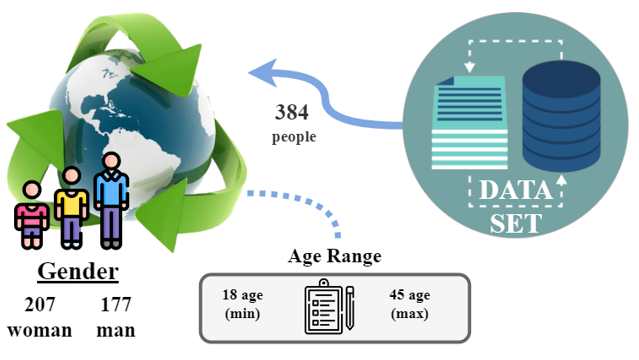
The study aims to examine people's attitudes towards the environment. Environmental education provides the necessary awareness to effectively address environmental issues. It is stated that attitudes towards the environment are very important and negative attitudes can worsen environmental problems. For this purpose, a dataset was obtained by using a scale consisting of 37 variables to a participant group consisting of 384 people. With this dataset, attitudes towards the environment have been analyzed using various classification algorithms. Logistic Regression (LR), Support Vector Machine (SVM) and Decision Tree (DT) models were used in the research. The LR, SVM, and DT models achieved 94.53%, 92.96%, and 82.55% classification success, respectively It is seen that the classification achievements of the models are at an acceptable level compared to the literature. As a result, the research sheds light on people's attitudes towards the environment through classification processes. Despite the acceptable classification achievements, alternative artificial Intelligence approaches can also be used to improve performance.

visibility1,313file_download756
Detecting Industrial Potato Chips Defects with Machine Learning Methods Using Deep Features
Research Articleslock_openOpen Access
pp. 63-69

Detecting Industrial Potato Chips Defects with Machine Learning Methods Using Deep Features

Gulsen TaspinarMurat Koklu

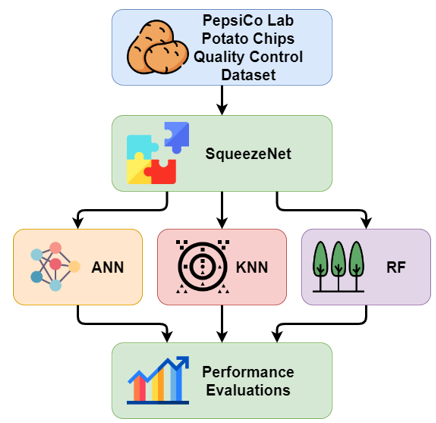
Detection of production defects in industrial foods is vital to protect consumer health. Early detection of these errors can minimize the economic losses of manufacturers by reducing the costs of recalls and production stoppages. Additionally, continuous monitoring and improvement of product quality can increase brand reliability and customer satisfaction. Image processing can detect product defects, minimize human error and increase efficiency by performing uninterrupted inspection on the production line. Based on these reasons, this study aimed to detect potato chip errors with image processing. PepsiCo Lab Potato Chips Quality Control image dataset was used in the study. There are two classes in the dataset: defective and not defective. There are 967 images in total. SqueezeNet Convolutional Neural Network (CNN) architecture was used to extract the features of the images. With this architecture, 1000 features obtained for each image were classified with Artificial Neural Network (ANN), K Nearest Neighbor (KNN), Random Forest (RF) machine learning methods. As a result of the classifications, 0.986 classification accuracy was obtained from the ANN model, 0.927 from the KNN model, and 0.962 from the RF model. F1 Score, precision, recall and specificity metrics were used to compare the models in detail. According to the data obtained from the experimental results, it is predicted that the proposed feature extraction and classification models can detect industrial production errors occurring in potato chips.

visibility1,627file_download814
Deep Learning-Based Classification of Skin Lesion Dermoscopic Images for Melanoma Diagnosis
Research Articleslock_openOpen Access
pp. 70-81

Deep Learning-Based Classification of Skin Lesion Dermoscopic Images for Melanoma Diagnosis

Humar KAHRAMANLI ORNEKBurak YILMAZElham YASINMurat KOKLU

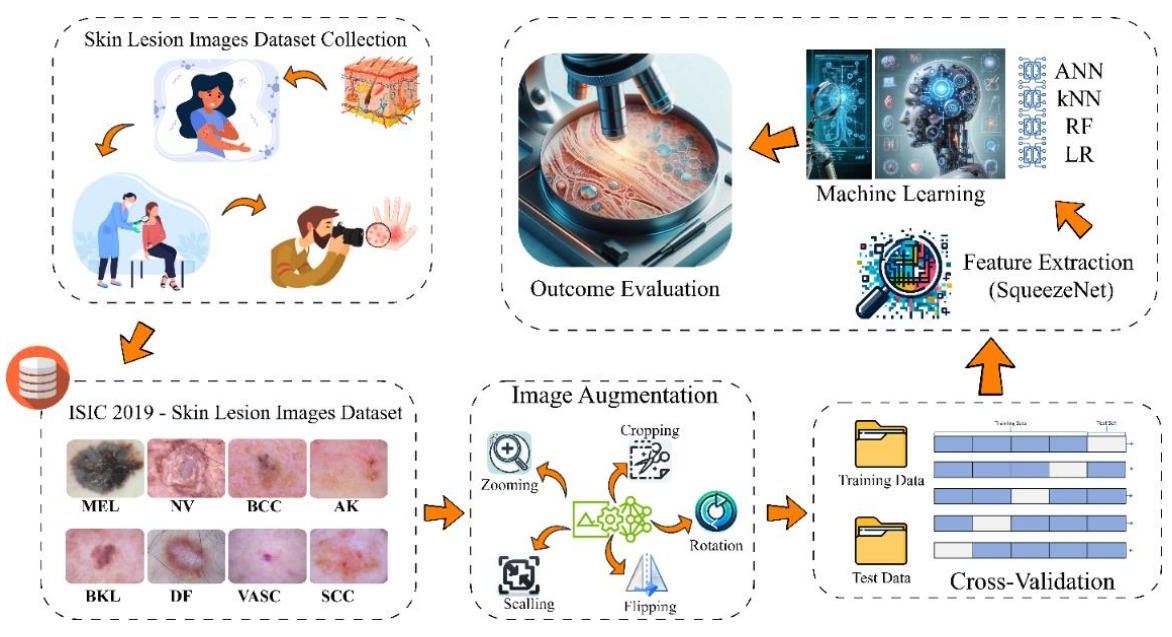
This study examined the effectiveness of artificial intelligence and machine learning methods in accurately categorizing skin cancers. We used the ISIC 2019 Skin Lesion dataset, which consists of images divided into eight categories. To prepare the data, we applied preprocessing techniques and extracted features using the SqueezeNet deep learning model. The dataset was divided into training and test sets using cross validation. Four well-known machine learning algorithms, namely Artificial Neural Network (ANN), k-nearest neighbors (kNN), Random Forest (RF), and Logistic Regression (LR), were employed to perform classification tasks. Each algorithm was specifically designed to suit its processing methodology. The algorithms are assessed based on several important measures. The results indicate that the Artificial Neural Network (ANN) achieved the highest accuracy rate of 71.80%, whereas the k-nearest neighbors (kNN), Random Forest (RF), and Logistic Regression (LR) achieved accuracy rates of 69.70%, 67.00%, and 67.20%, respectively. The results emphasize the capacity of machine learning algorithms to augment clinical decision-making in the field of dermatology, with the goal of enhancing early detection and treatment effectiveness for individuals with skin cancer.

visibility1,584file_download795