Data-Driven Prediction of Processing Times and Delays Across Supply Chain Operational Stages Using Machine Learning
DOI:
https://doi.org/10.58190/imiens.2026.176Keywords:
Data Entry Time Prediction, Gradient Boosting, Machine learning, Operational Decision Support, Supply Chain Operations, Temporal Data SplittingAbstract
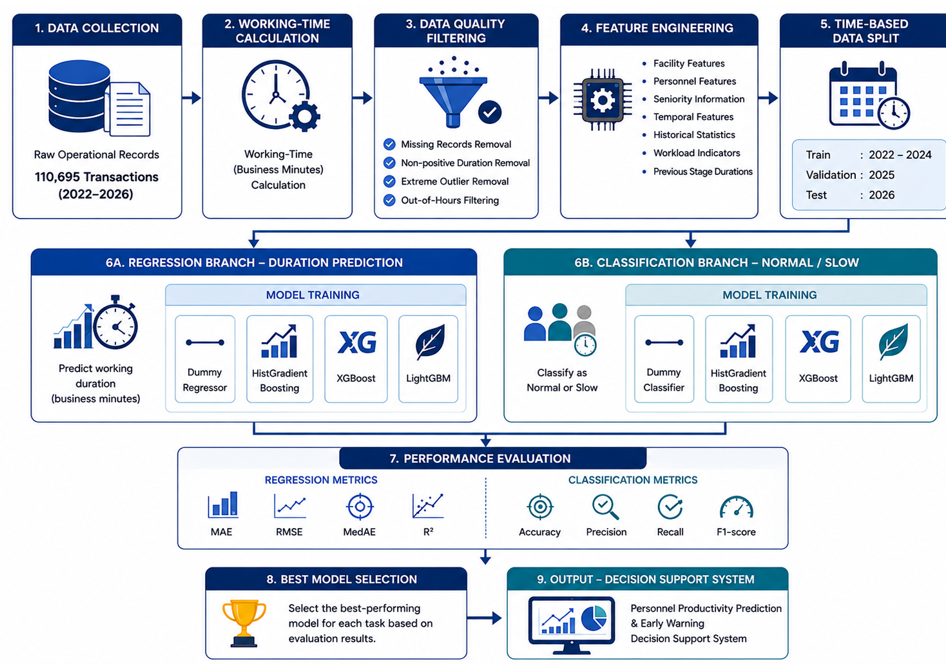
This study proposes an ensemble learning framework to predict personnel data entry durations across six operational stages using transaction records collected from an operational supply chain information system. To accurately represent operational performance, processing times were calculated in working minutes by excluding nonworking periods, including nights and weekends. The dataset comprised 110,695 unique shipment records collected between 2022 and 2026 and underwent stage-specific data quality assessment and preprocessing. A median-based baseline predictor and three ensemble learning algorithms, HistGradientBoosting, XGBoost, and LightGBM, were evaluated for regression tasks. All models were trained on a log-transformed target (log1p), and predictions were back-transformed to working minutes using the inverse transformation (expm1). To prevent data leakage and better reflect real-world deployment, a year-based temporal split was adopted, with 2026 records reserved for testing. Model performance was evaluated using mean absolute error, root mean square error, coefficient of determination, accuracy, precision, recall, and F1-score. A single regression model was trained per stage, and binary labels (normal/slow) were derived by thresholding the predicted durations at a stage-specific cut-off optimized on the validation set. The results showed that predictive performance varied substantially across operational stages, with LightGBM achieving the best overall performance for the Loading Arrival stage, while lower performance in the Transport Entry and unloading stages suggested the influence of external operational factors not represented in the available data. For the Loading Arrival stage, LightGBM achieved an MAE of 285.989 working minutes and an R² of 0.371 on the test set. Overall, the findings demonstrate that ensemble learning provides an effective and computationally efficient approach for predicting personnel data entry durations and supports real-time decision-making, personnel performance monitoring, and process optimization in data-driven supply chain operations.
Downloads
References
[1] A. S. Lather, R. Malhotra, P. Saloni, P. Singh, and S. Mittal, "Prediction of employee performance using machine learning techniques," in Proceedings of the 1st international conference on advanced information science and system, 2019, pp. 1–6, doi: 10.1145/3373477.3373654.
[2] P. Tambe, P. Cappelli, and V. Yakubovich, "Artificial intelligence in human resources management: Challenges and a path forward," California management review, vol. 61, no. 4, pp. 15–42, 2019, doi: 10.1177/0008125619867910.
[3] P. R. Palos-Sánchez, P. Baena-Luna, A. Badicu, and J. C. Infante-Moro, "Artificial intelligence and human resources management: A bibliometric analysis," Applied artificial intelligence, vol. 36, no. 1, p. 2145631, 2022, doi: 10.1080/08839514.2022.2145631.
[4] A. Uppal, Y. Awasthi, and A. Srivastava, "Machine learningbased approaches for enhancing human resource management using automated employee performance prediction systems," International Journal of Organizational Analysis, vol. 33, no. 8, pp. 2307–2346, 2025, doi: 10.1108/IJOA-07-2024-4643.
[5] M. Awada, B. Becerik-Gerber, G. Lucas, and S. C. Roll, "Predicting office workers’ productivity: A machine learning approach integrating physiological, behavioral, and psychological indicators," Sensors, vol. 23, no. 21, p. 8694, 2023, doi: 10.3390/s23218694.
[6] S. Koldijk, M. A. Neerincx, and W. Kraaij, "Detecting work stress in offices by combining unobtrusive sensors," IEEE Transactions on affective computing, vol. 9, no. 2, pp. 227–239, 2016, doi: 10.1109/TAFFC.2016.2610975.
[7] L. Shu et al., "Wearable emotion recognition using heart rate data from a smart bracelet," Sensors, vol. 20, no. 3, p. 718, 2020, doi: 10.3390/s20030718.
[8] C.-T. Li, J. Cao, and T. M. Li, "Eustress or distress: An empirical study of perceived stress in everyday college life," in Proceedings of the 2016 ACM international joint conference on pervasive and ubiquitous computing: Adjunct, 2016, pp. 1209–1217, doi: 10.1145/2968219.2968309.
[9] E. V. Orlova, "Innovation in company labor productivity management: Data science methods application," Applied System Innovation, vol. 4, no. 3, p. 68, 2021, doi: 10.3390/asi4030068.
[10] T. Nguyen, Z. Li, V. Spiegler, P. Ieromonachou, and Y. Lin, "Big data analytics in supply chain management: A state-of-the-art literature review," Computers & operations research, vol. 98, pp. 254–264, 2018, doi: 10.1016/j.cor.2017.07.004.
[11] G. Kannan, T. C. E. Cheng, M. Nishikant, and S. Nagesh, "Big data analytics and application for logistics and supply chain management," Transportation Research Part E: Logistics and Transportation Review, vol. 114, pp. 343–349, 2018, doi: 10.1016/j.tre.2018.03.011.
[12] Y. Riahi, T. Saikouk, I. Badraoui, and S. Fosso Wamba, "Researched topics, patterns, barriers and enablers of artificial intelligence implementation in supply chain: a Latent-Dirichlet-allocation-based topic-modelling and expert validation," Production Planning & Control, vol. 36, no. 5, pp. 565–592, 2025, doi: 10.1080/09537287.2023.2286523.
[13] W. M. Van der Aalst, M. H. Schonenberg, and M. Song, "Time prediction based on process mining," Information systems, vol. 36, no. 2, pp. 450–475, 2011, doi: 10.1016/j.is.2010.09.001.
[14] F. M. Maggi, C. Di Francescomarino, M. Dumas, and C. Ghidini, "Predictive monitoring of business processes," in International conference on advanced information systems engineering, 2014: Springer, pp. 457–472, doi: 10.1007/978-3-319-07881-6_31.
[15] I. Verenich, M. Dumas, M. L. Rosa, F. M. Maggi, and I. Teinemaa, "Survey and cross-benchmark comparison of remaining time prediction methods in business process monitoring," ACM Transactions on Intelligent Systems and Technology (TIST), vol. 10, no. 4, pp. 1–34, 2019, doi: 10.1145/3331449.
[16] J. H. Friedman, "Greedy function approximation: a gradient boosting machine," Annals of statistics, pp. 1189–1232, 2001, doi: 10.1214/aos/1013203451.
[17] T. Chen and C. Guestrin, "Xgboost: A scalable tree boosting system," in Proceedings of the 22nd acm sigkdd international conference on knowledge discovery and data mining, 2016, pp. 785–794, doi: 10.1145/2939672.2939785.
[18] L. Grinsztajn, E. Oyallon, and G. Varoquaux, "Why do tree-based models still outperform deep learning on typical tabular data?," Advances in Neural Information Processing Systems, vol. 35, 2022 [Online]. Available: https://proceedings.neurips.cc/paper_files/paper/2022/file/0378c7692da36807bdec87ab043cdadc-Paper-Datasets_and_Benchmarks.pdf.
[19] H. Yang and L. Yang, "Asymmetric effects of attribute performance on transit satisfaction among older adults: machine learning regression with dummy variables," International Journal of Environmental Science and Technology, vol. 23, no. 3, p. 194, 2026, doi: 10.1007/s13762-025-07004-0.
[20] B. Marina, I. Memon, F. A. Alvi, U. Rajput, and M. Nabi, "Machine Learning-Driven Security and Privacy Analysis of a Dummy-ABAC Model for Cloud Computing," Computers, vol. 14, no. 10, p. 420, 2025, doi: 10.3390/computers14100420.
[21] M. Tamim Kashifi and I. Ahmad, "Efficient histogram-based gradient boosting approach for accident severity prediction with multisource data," Transportation research record, vol. 2676, no. 6, pp. 236–258, 2022, doi: 10.1177/03611981221074370.
[22] N. Lingling et al., "Streamflow forecasting using extreme gradient boosting model coupled with Gaussian mixture model," Journal of Hydrology, vol. 586, p. 124901, 2020, doi: 10.1016/j.jhydrol.2020.124901.
[23] H. Incekara, I. H. Cizmeci, M. M. Saritas, and M. Koklu, "Classification of almond kernels with optuna hyper-parameter optimization using machine learning methods," Journal of Food Science and Technology, pp. 1–17, 2025, doi: 10.1007/s13197-025-06494-7.
[24] A. C. Citak, S. S. Bayram, and M. Koklu, "Classification of obesity levels using machine learning algorithms," Intelligent Methods in Engineering Sciences, vol. 4, no. 3, pp. 100–113, 2025, doi: 10.58190/imiens.2025.157.
[25] G. Ke, Q. Meng, T. Finley, T. Wang, W. Chen, W. Ma, Q. Ye, and T.-Y. Liu, “LightGBM: A highly efficient gradient boosting decision tree,” in Advances in Neural Information Processing Systems, vol. 30, pp. 3146–3154, 2017.
[26] M. M. Saritas, Y. S. Taspinar, I. Cinar, and M. Koklu, "Railway track fault detection with ResNet deep learning models," in 2023 International Conference on Intelligent Systems and New Applications (ICISNA’23), Liverpool, United Kingdom, Apr. 28–30, 2023, pp. 66–71, E-ISBN: 978-605-72180-3-2.
[27] M. Koklu, B. Isgor, and C. Tumer, "Hybrid Feature-Based Two-Stage Framework for Audio Deepfake Detection and Generative Model Attribution," Advances in Engineering and Intelligence Systems, vol. 5, no. 01, pp. 241–259, 2026, doi: 10.22034/aeis.2026.566863.1400.
[28] K. Sabanci, M. Koklu, and M. F. Unlersen, "Classification of Siirt and long type pistachios (pistacia vera l.) by artificial neural networks," International Journal of Intelligent Systems and Applications in Engineering, vol. 3, no. 2, pp. 86–89, 2015, doi: 10.18201/ijisae.74573.
[29] B. Unver, M. T. Yoldar, S. Ozkan, and M. Koklu, "Vision Transformers in Person Re-Identification: A Review," IEEE Access, vol. 14, pp. 92748–92764, 2026, doi: 10.1109/ACCESS.2026.3704666.
[30] Ü. Yavuz, U. Ekim, and M. Köklü, "Üniversite Öğrencilerin Ortak Zorunlu Derslerdeki Başarılarının K-Means Algoritması İle İncelenmesi," NWSA: Engineering Sciences, vol. 6, no. 1, pp. 342–347, 2011.
[31] Ö. Yılmaz, A. Altun, and M. Köklü, "A new hybrid algorithm based on MVO and SA for function optimization," International Journal of Industrial Engineering Computations, vol. 13, no. 2, pp. 237–254, 2022.
[32] O. Kilci, Y. Eryesil, and M. Koklu, "Classification of Biscuit Quality With Deep Learning Algorithms," Journal of Food Science, vol. 90, no. 7, p. e70379, 2025, doi: 10.1111/1750-3841.70379.
[33] O. Kilci and M. Koklu, "Machine learning-based detection of solar panel surface defects using deep features from InceptionV3," in 4th International Conference on Trends in Advanced Research Konya, Türkiye, Jul. 4–5, 2025, p. 59.
Downloads
Published
Issue
Section
License
Copyright (c) 2026 Intelligent Methods In Engineering Sciences

This work is licensed under a Creative Commons Attribution-ShareAlike 4.0 International License.
How to Cite